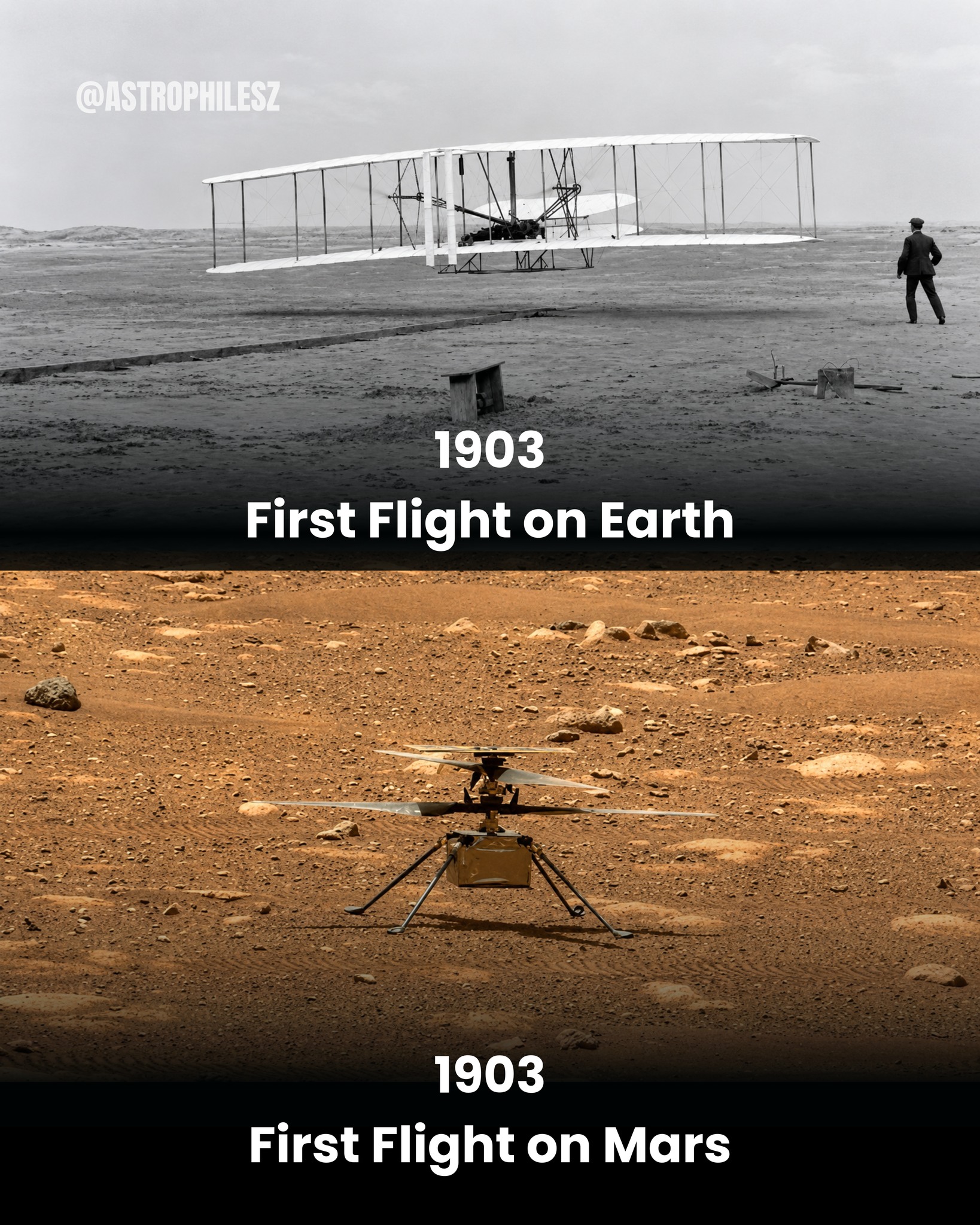
“The Wright brothers’ 1903 flight and NASA Ingenuity’s 2021 Mars flight were separated by about 117 years, with Ingenuity achieving the first powered, controlled flight on another world.”
IG
@astrophileszPost analyzed by Clear
WHAT CLEAR'S RESEARCH SAYS
SUPPORTED BY EVIDENCE
Confidence98%
“A 12-second beach hop to autonomous Martian flight is a genuinely accurate milestone arc.”
TL;DR
Established evidence supports the post’s central comparison: the Wrights’ 1903 flight and Ingenuity’s April 19, 2021 Mars flight were landmark first powered, controlled flights in their respective settings. The broader lesson about technological progress is an interpretation, but a reasonable one. The Mars slide’s “1903” label is an apparent error, though the caption correctly describes the 117-year interval.
What holds up
The Wright Flyer’s first flight lasted 12 seconds and traveled about 120 feet. Ingenuity climbed to 3 meters, hovered, landed, and flew for 39.1 seconds on April 19, 2021—the first powered, controlled flight on another planet. Mars’s thin atmosphere and communications delay required autonomous onboard flight control. Ingenuity also carried a small piece of Wright Flyer wing fabric.
What does not
Slide 1 labels the Mars flight as “1903,” which is incorrect; Ingenuity’s first Mars flight occurred in 2021.
Why it matters
The erroneous slide date is noticeable but does not materially change the central takeaway because the caption explicitly states that 117 years separated the events and accurately describes the Mars flight.
Why Clear says this
Smithsonian records identify the Wrights’ December 17, 1903 flight as a 12-second, 120-foot powered flight. NASA records confirm Ingenuity’s April 19, 2021 autonomous 39.1-second flight to 3 meters, Mars’s roughly 1% surface atmospheric density relative to Earth, and the Flyer fabric carried aboard.
Evidence
The National Air and Space Museum documents Orville Wright’s December 17, 1903 flight as 12 seconds and 120 feet.
NASA documents Ingenuity’s April 19, 2021 flight as a 39.1-second ascent to 3 meters, hover, and landing—the first powered, controlled flight on another planet.
NASA states that Ingenuity flew autonomously because it could not be joystick-controlled from Earth in real time, and that it carried a small Wright Flyer fabric swatch.
Language: EnglishChecked 24 Aug 2026, 7:57 amAI-assisted evidence check · Sources remain the final authorityPermanent public research record · Corrections and removal requests supported
Did this make the post clearer?Your feedback helps us catch bad calls.