“A four-month MIT study found frequent ChatGPT use caused a 47% drop in neural connectivity and poor recall, supporting the lesson that AI should not replace thinking.”
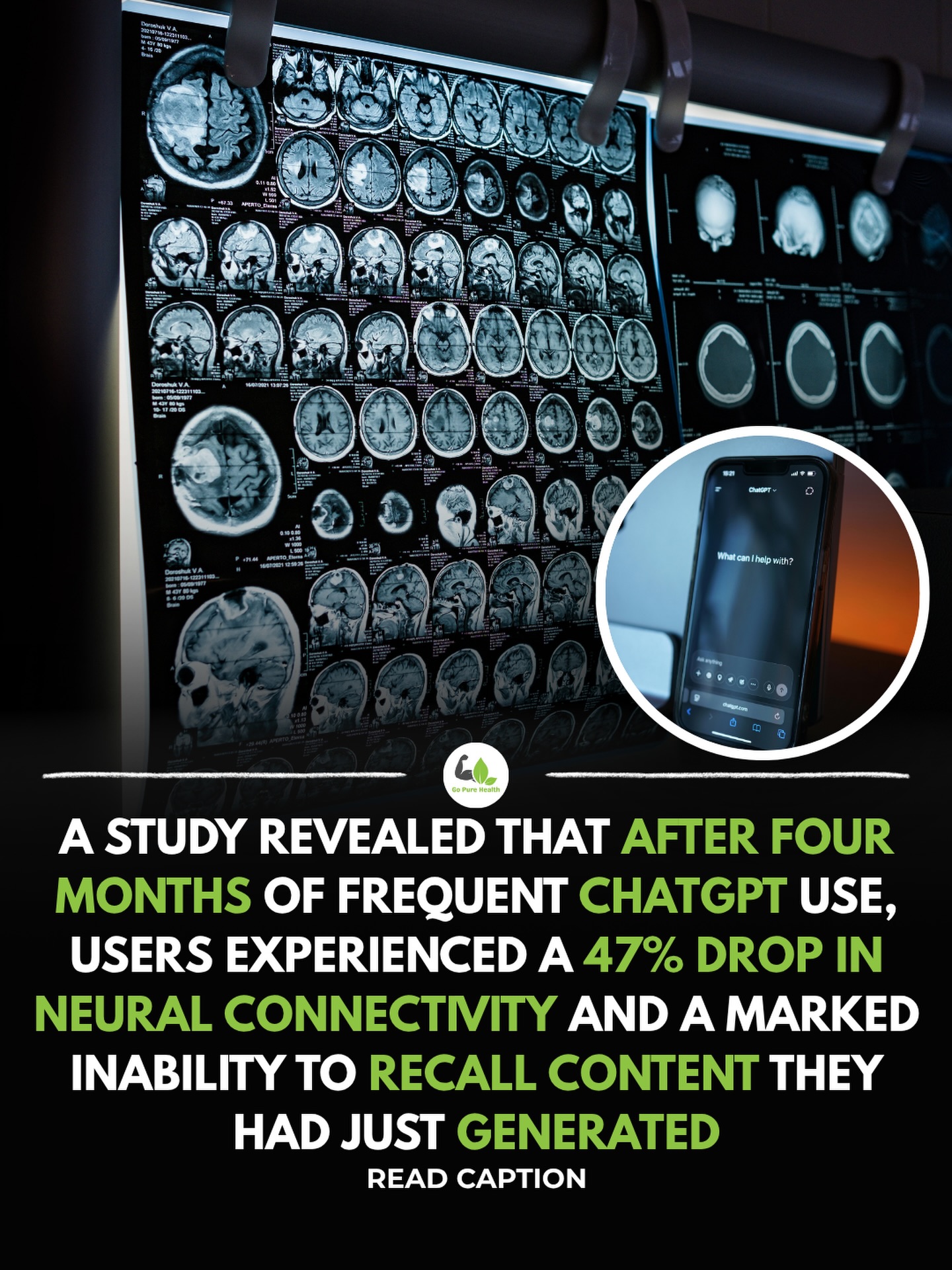
@gopurehealthPost analyzed by Clear
“A useful caution, but the dramatic percentage outruns what this preliminary study established.”
MIT Media Lab researchers reported that, during a specific essay-writing experiment, the LLM group had the weakest EEG connectivity and had more difficulty quoting their own work. The post also accurately notes that the work was preliminary, small, context-specific, and not evidence that ChatGPT damages brains.
The slide's claim of a 47% drop is not reported in the MIT paper or its project summary. It also reframes four essay-writing sessions spread across four months as four months of frequent ChatGPT use, which overstates the exposure and suggests a broader, lasting effect that the study did not measure.
Material. A precise 47% decline after frequent use makes viewers likely to infer a large, general, persistent cognitive effect. The actual evidence concerns task-related EEG patterns in a limited essay-writing protocol with 54 participants in the first three sessions and 18 in the fourth.
Why Clear says this
The central caution about relying on AI to produce essays is compatible with the study's findings, and the caption includes important limitations. But the prominent unsupported percentage and overstated exposure materially exaggerate the scale and scope of the evidence. MIT says the findings are preliminary, context-dependent, not generalizable across tasks, and should not be described as brain damage or as making people dumber. A subsequent scholarly comment also raised concerns about sample size, reproducibility, EEG methods, reporting consistency, and transparency.
Evidence
- MIT's project summary says 54 participants completed the first three sessions and 18 completed the fourth; participants wrote essays with an LLM, search engine, or no tools.
- MIT reports the LLM group showed the weakest overall task-related EEG coupling and greater difficulty quoting essays they had written minutes earlier.
- MIT describes the work as an unreviewed preprint, says it is context-dependent to educational essay writing, and lists major limits on generalization.
- Neither the MIT project summary nor the preprint abstract reports a 47% neural-connectivity decline.
- An independent scholarly comment identified methodological and reporting concerns that warrant conservative interpretation.