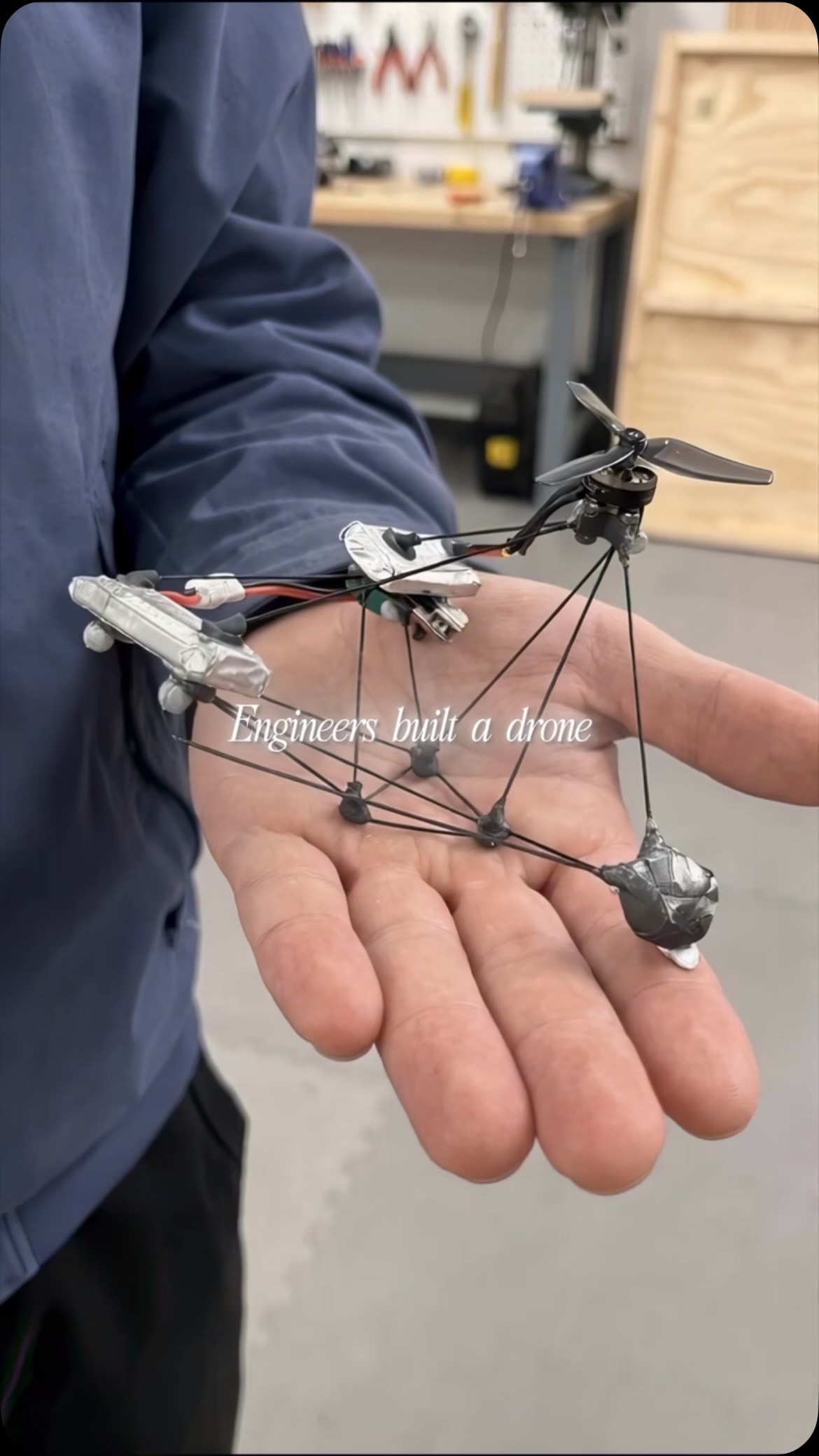
“Northwestern engineers built Phantom Twist, a drone that becomes nearly invisible to human observers by spinning its whole body rapidly rather than using camouflage.”
@itsnicconleyReel analyzed by Clear
“A spinning blur, carefully engineered to fade into the background.”
The published research describes a single-propeller UAV whose airframe rotates opposite its propeller, at roughly 15 to 25 rotations per second. Its automated design process generated about 20,000 feasible configurations and optimized component placement to reduce a human-aligned visibility metric. Flight tests found the optimized design substantially less visually perceptible than conventional quadcopters.
It does not become literally invisible; the researchers describe a faint translucent haze, with some wires and support rods still visible. The post’s claim that every stealth system was designed to defeat a sensor is an unsupported absolute and overlooks camouflage and other approaches intended to reduce human detection.
These caveats do not materially overturn the main takeaway: this prototype was specifically engineered to reduce visual detectability through rapid rotation and layout optimization, rather than conventional camouflage.
Why Clear says this
The central claim matches the authors’ paper and independent technical reporting. The paper reports stable, controllable flight tests and reduced visual perceptibility, while also making clear that the result is low visibility, not invisibility. Its visibility comparison relies mainly on a perceptual-image metric and prototype demonstrations, so performance will vary with background, viewing conditions, and observer.
Evidence
- The preprint reports Phantom Twist as a single-propeller UAV designed for low visibility through high-speed spinning and motion blur, with fabricated and flight-tested prototypes.
- The paper reports roughly 20,000 feasible configurations, followed by optimization of the 500 lowest-visibility candidates.
- The researchers report that component overlap and parts near the rotation axis increase visibility; distributing components at different heights and angles reduces conspicuous dark features.
- Northwestern states the prototype spins up to 25 times per second and is not completely invisible; it appears as a ghostly smudge, while noise and some structural elements remain limitations.
- IEEE Spectrum independently reports the work as a conference demonstration and describes the design as computationally optimized for low visibility, while noting that spinning drones themselves are not new.