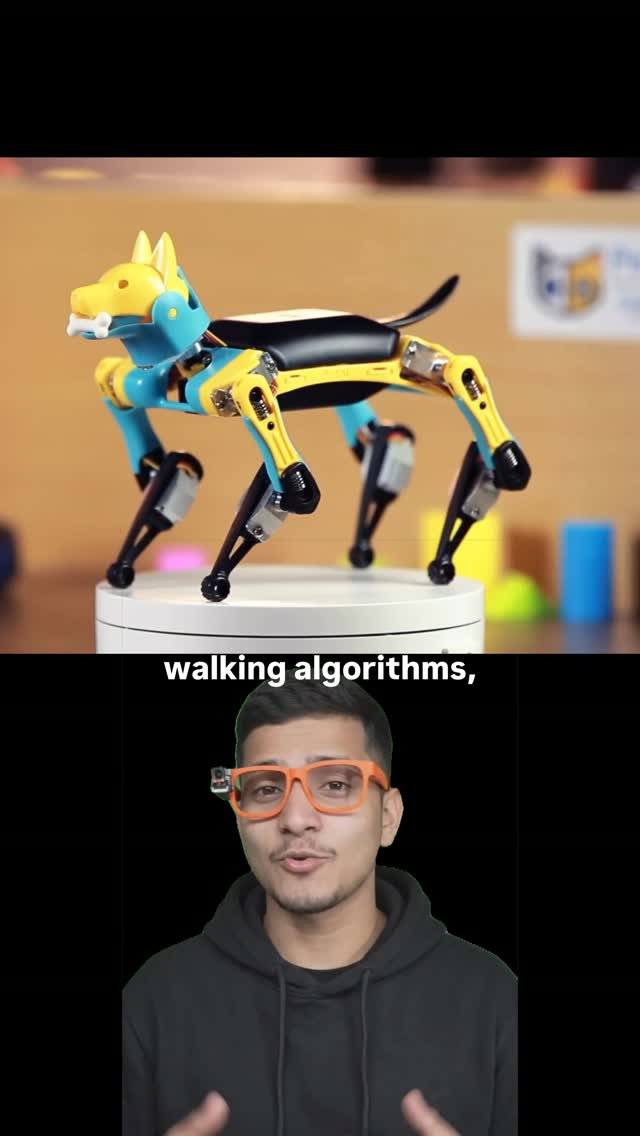
“OpenCat lets people use free open-source resources and 3D-printable parts to build a home robot dog with walking and control software.”
@vaishabhjalmiReel analyzed by Clear
“A real open-source quadruped project, with a few more parts than filament.”
The repository is public and MIT-licensed. Its documentation describes OpenCat as an Arduino- and Raspberry Pi-based quadruped framework that handles gait coordination, servo control, and IMU integration. Petoi's linked public file repository includes 3D-printable parts for its robots.
The simple phrasing can suggest that downloading files and printing plastic alone produces a complete robot. The available documentation says some parts are unsuitable for 3D printing, and a working build also requires purchased hardware such as servos, a controller, battery, and other components.
Not material to the central takeaway. The post says it provides 3D-printable parts rather than promising that every component is printable or that the full robot costs nothing.
Why Clear says this
The core claim is substantially accurate: OpenCat provides openly available robot-control software and printable components that can support a home-built quadruped. The project-origin and popularity language is secondary, and its exact comparative popularity is not necessary to the main claim.
Evidence
- GitHub lists OpenCat as a public MIT-licensed repository and describes its gait coordination, servo control, and IMU integration.
- GitHub lists a separate public Petoi repository containing an STL directory; its README says it contains 3D-printable parts and notes that some parts are not suitable for 3D printing.
- The project documentation identifies the framework as supporting quadruped robot builds rather than supplying a fully printable, electronics-free robot.