“Short-form, highly processed digital content is sending brains into steep cognitive and emotional decline, particularly among young people.”
@bradstulberg6 slides analyzed by Clear
“Useful boundaries, but the research tracks risks more clearly than irreversible brain decline.”
A large meta-analysis found that greater short-form-video engagement is associated with poorer cognition, especially attention and inhibitory control, and with poorer mental-health indicators. Setting personal boundaries around use is a reasonable practical suggestion.
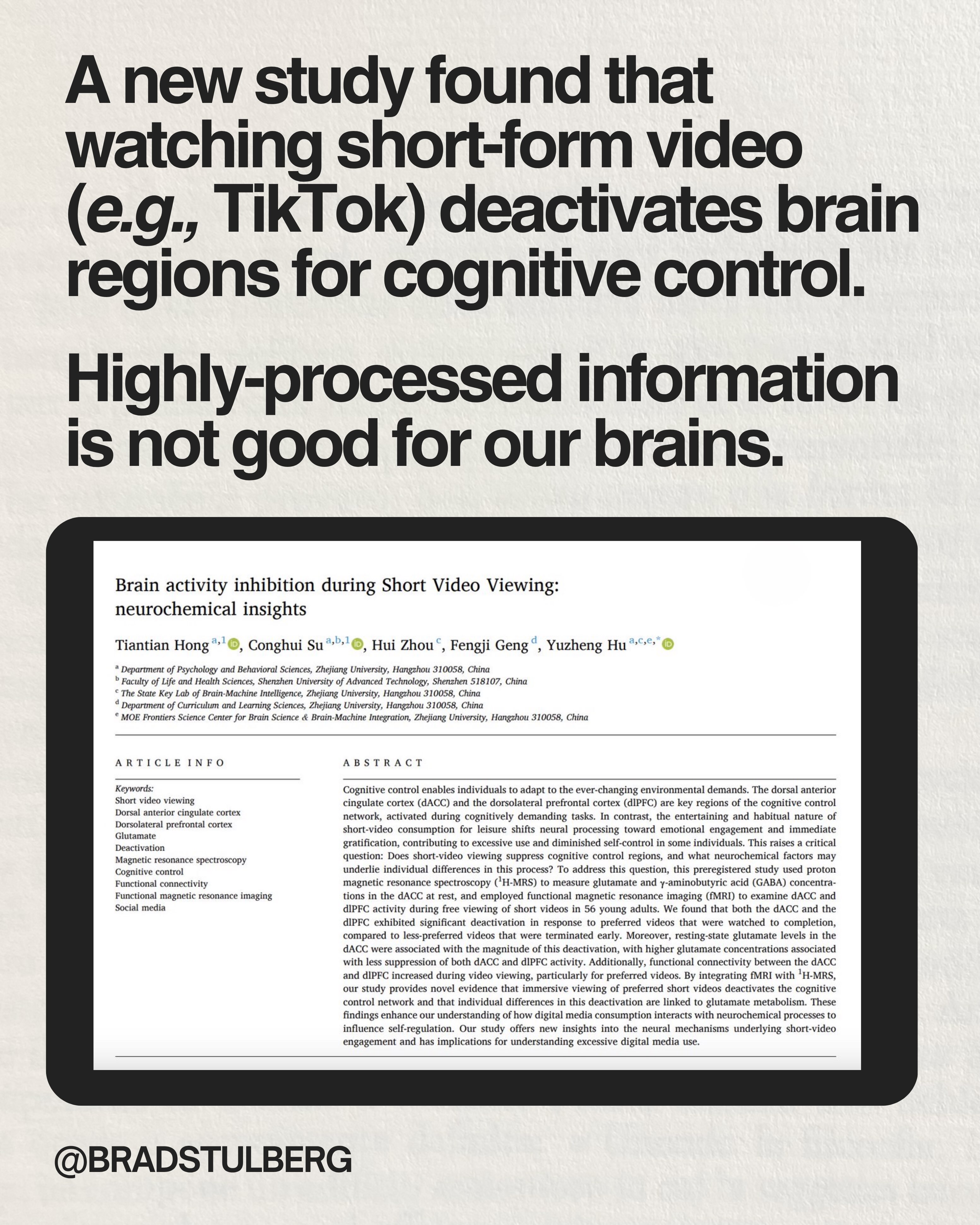
The post turns associations and a small laboratory brain-imaging result into a strong causal story of brains going off a steep cliff. The imaging study measured momentary activity differences while 56 young adults watched preferred versus less-preferred videos; it did not show lasting neural damage or neural changes among regular users. The depression study was a cross-sectional mediation model using self-reported brain-rot measures, so it cannot show that digital content caused burnout, anxiety, or depression.
This missing context materially changes the takeaway. The evidence supports concern about heavier or problematic use being linked to poorer outcomes, not the claim that ordinary exposure to short videos broadly causes severe, lasting cognitive or emotional deterioration—especially in all young people.
Why Clear says this
The strongest directly relevant evidence is correlational. A 2025 meta-analysis of 71 studies and 98,299 participants found meaningful associations between greater short-form-video use and poorer attention and inhibitory control, plus weaker overall mental-health associations. But its authors state that most included studies were cross-sectional and correlational, leaving directionality unresolved: preexisting anxiety, attention difficulties, or other factors may also lead people to use more short-form video. Evidence about adolescent social-media use likewise finds small associations and cannot establish causation. The cited fMRI study supports a narrower finding—deactivation in cognitive-control regions during immersive viewing of preferred videos—not a finding of enduring impairment.
Evidence
- A meta-analysis covering 71 studies and 98,299 participants found that higher short-form-video use was associated with poorer cognition and mental-health indicators.
- That meta-analysis says most included studies were cross-sectional and correlational, so it cannot determine whether short-form-video use causes the observed outcomes.
- The cited NeuroImage experiment studied 56 young adults and found different brain activity during preferred short-video viewing; it did not test lasting harm or compare habitual users with nonusers.
- The cited brain-rot/depression paper surveyed 439 participants and reported an indirect statistical pathway, not direct causation by short-form media.
- A JAMA Pediatrics meta-analysis found small associations between adolescent social-media use and internalizing symptoms and explicitly states that its pooled correlations cannot support causal inference.