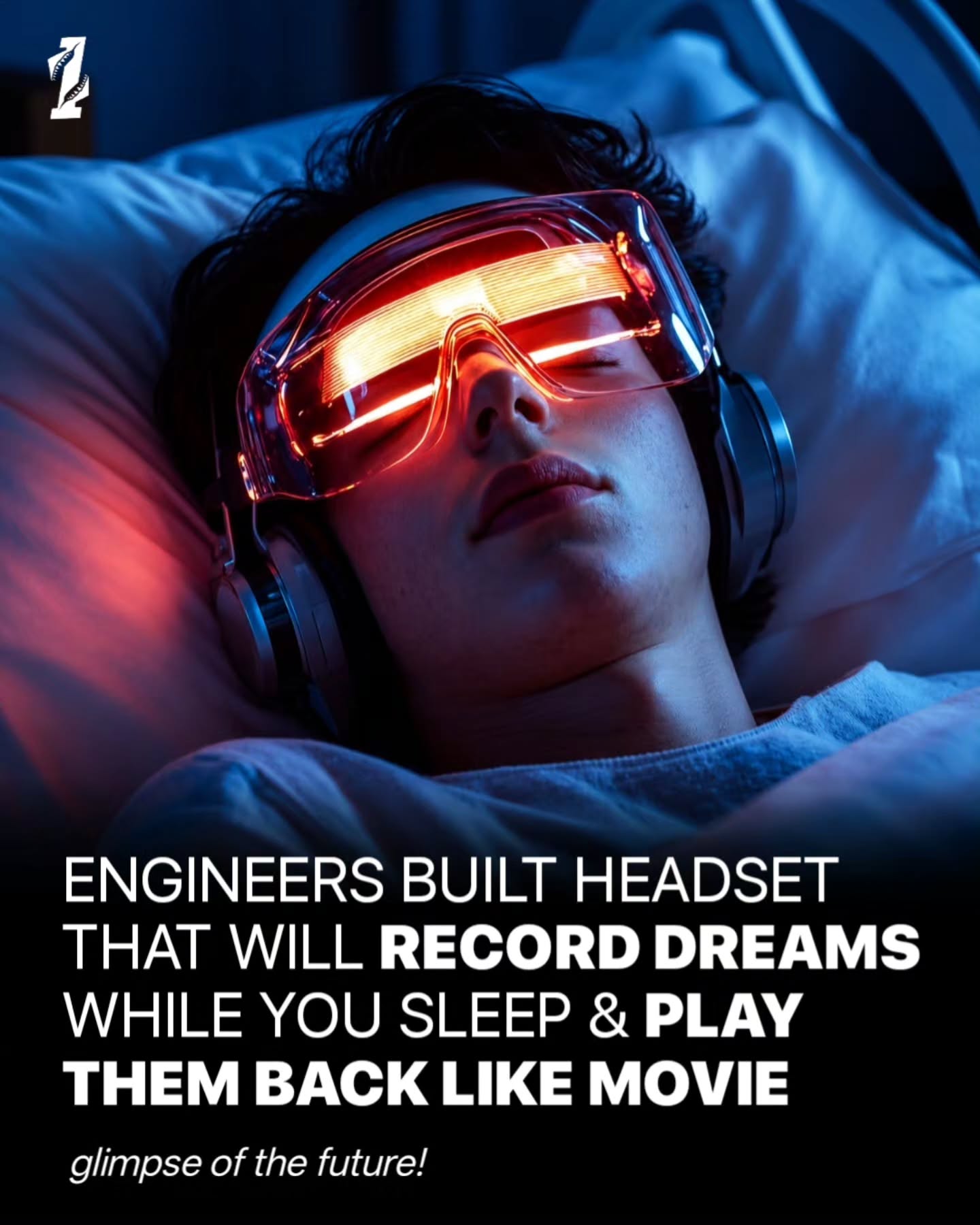
“Japanese researchers have built a headset that records dreams during REM sleep and plays them back as movie-like visualizations.”
@inventionsharkPost analyzed by Clear
“Cool premise, but the science decodes rough categories—not dream movies.”
A real 2013 ATR study led by researchers including Yukiyasu Kamitani used fMRI and machine learning to predict some broad visual-object categories from participants’ verbal reports of imagery during sleep onset. Reported performance for certain limited classifications was roughly in the 60–70% range. ([pubmed.ncbi.nlm.nih.gov](https://pubmed.ncbi.nlm.nih.gov/23558170/?utm_source=openai))
The study did not use a consumer-style headset, did not establish decoding during REM sleep, and did not reconstruct or replay dreams as videos. ATR explicitly says its demonstration was not a reconstruction of dream shape or color; it showed category-linked example images. ([bicr.atr.jp](https://bicr.atr.jp/dni/en/2013/04/dream-decoding-video/?utm_source=openai))
These omissions change the core impression from a small, individualized fMRI experiment classifying limited categories to a nonexistent technology that can record and replay a person’s dreams.
Why Clear says this
The central takeaway is that dream movies can now be recorded and played back. Reliable evidence directly conflicts with that: the underlying research measured three people in an fMRI scanner around sleep onset, relied on repeated awakenings and self-reports, and decoded limited categories rather than full visual scenes or narratives. The claimed REM-sleep capability is also not what the foundational study tested. ([pubmed.ncbi.nlm.nih.gov](https://pubmed.ncbi.nlm.nih.gov/23558170/?utm_source=openai))
Evidence
- The peer-reviewed 2013 study describes prediction of visual-imagery contents during the sleep-onset period using fMRI and models linked to verbal reports, not video reconstruction. ([pubmed.ncbi.nlm.nih.gov](https://pubmed.ncbi.nlm.nih.gov/23558170/?utm_source=openai))
- ATR’s own explanation says its displayed images were examples of likely semantic categories and were not reconstructions of dream shape or color. ([bicr.atr.jp](https://bicr.atr.jp/dni/en/2013/04/dream-decoding-video/?utm_source=openai))
- Independent review literature distinguishes the sleep-onset imagery studied by Horikawa and colleagues from REM dreaming. ([pmc.ncbi.nlm.nih.gov](https://pmc.ncbi.nlm.nih.gov/articles/PMC6007136/?utm_source=openai))