“OpenAI may have cracked the Navier–Stokes problem; the proof is not officially accepted yet, but validation would be a huge AI moment.”
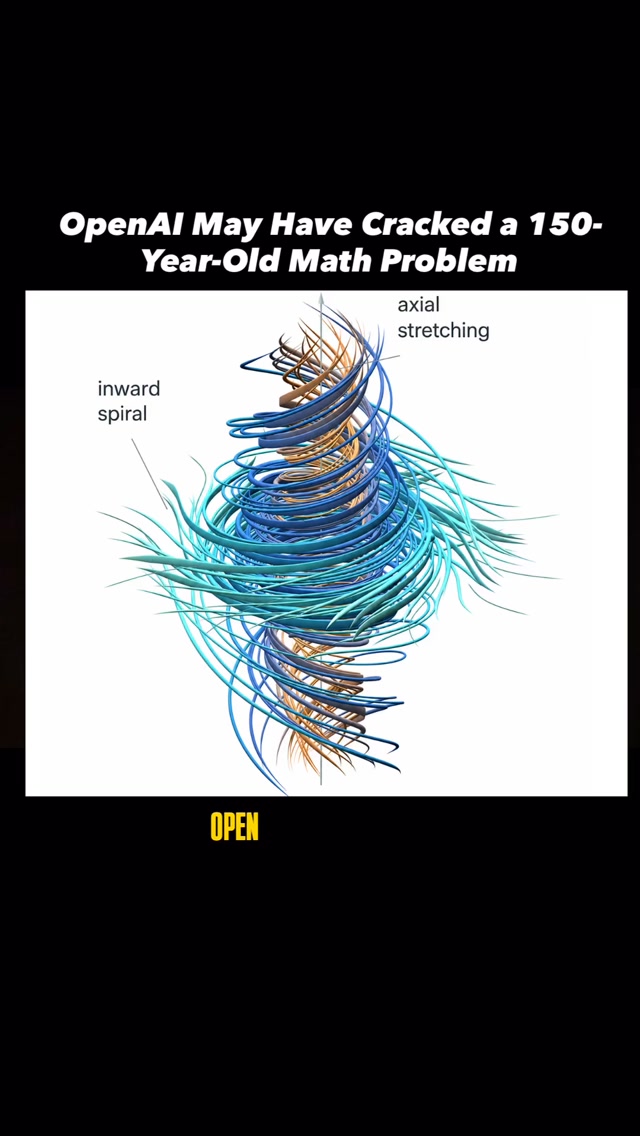
@anksmashReel analyzed by Clear
“A serious claim, responsibly framed: now the proof needs mathematicians, not momentum.”
OpenAI has publicly released a 166-page proof claiming finite-time singularity formation for three-dimensional incompressible Navier–Stokes flow with smooth forcing. The Navier–Stokes equations govern fluids including water and air. The post correctly emphasizes that the result remains unaccepted and conditional on verification.
Calling it a 150-year-old problem is imprecise: the equations date to the 19th century, while the specific modern existence-and-smoothness question has been central for roughly 90 years.
That age shorthand does not materially change the main takeaway. The post's hedging prevents viewers from reasonably interpreting the claim as an already established solution.
Why Clear says this
Clay Mathematics Institute still lists Navier–Stokes as unsolved and requires publication, two years, and general acceptance by the global mathematics community before considering a proposed solution. Independent reporting says outside mathematicians had not yet verified OpenAI's newly released proof.
Evidence
- OpenAI published a proof claiming a finite-time singularity in the relevant Navier–Stokes formulation.
- Clay Mathematics Institute currently lists the Navier–Stokes problem as unsolved.
- Clay's rules require general mathematical acceptance and at least two years after qualifying publication before it will consider a solution.
- No independent verification of the newly released proof was reported at the time of review.