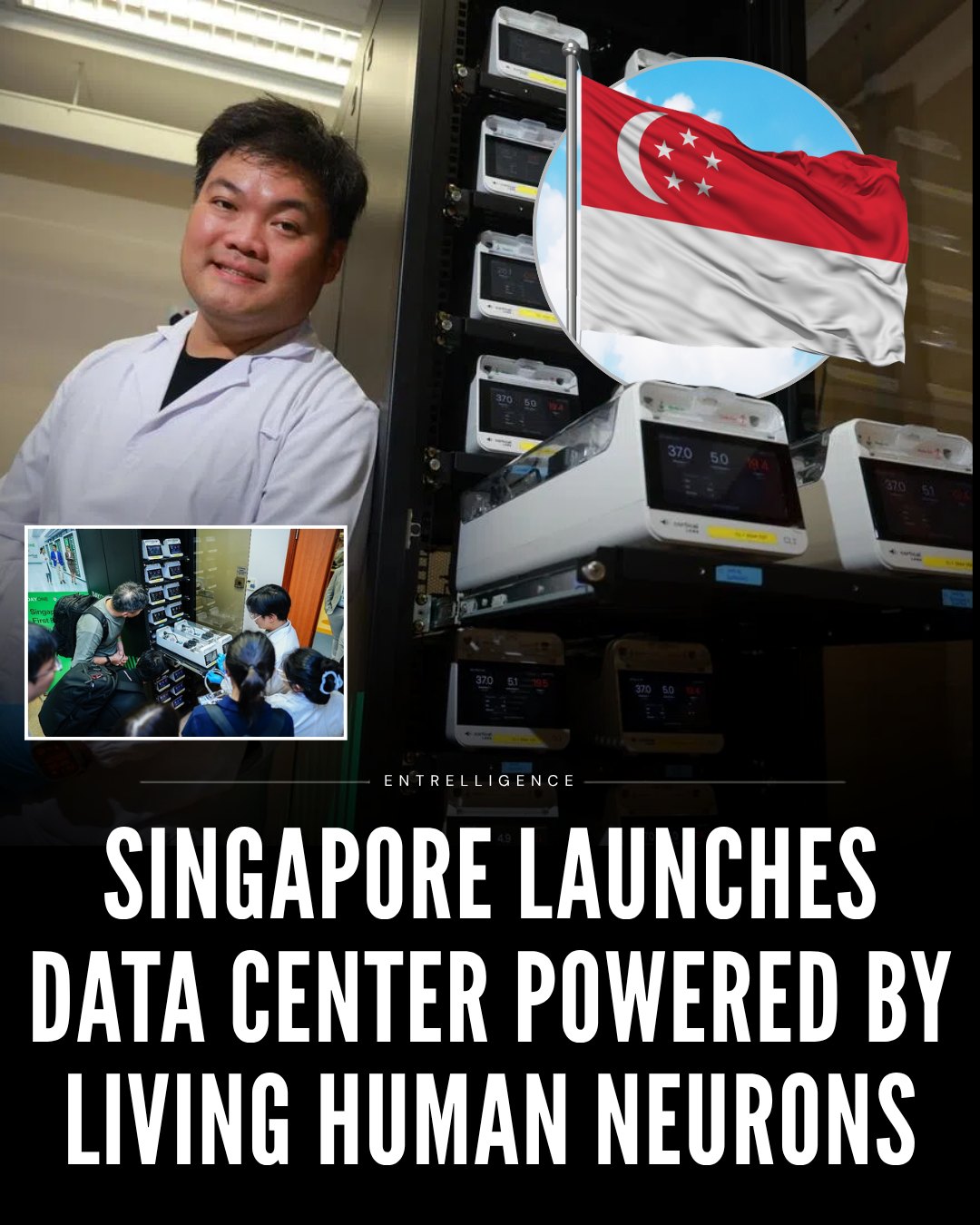
“Singapore launched an experimental biological data-centre prototype at NUS using 20 Cortical Labs neuron-and-silicon computing units, described as containing about 16 million lab-grown human neurons in total.”
@entrelligence4 slides analyzed by Clear
“Real neurons, real prototype, and still plenty of silicon in the rack.”
NUS Medicine confirms it partnered with DayOne and Melbourne-based Cortical Labs to establish a biological data-centre prototype at NUS. The initial deployment is one rack of 20 Cortical Cloud units. These systems use living neurons grown from stem cells and interface them with silicon hardware through electrical signals. CL1 systems are reported to contain about 800,000 lab-grown human neurons each, making 16 million a reasonable calculation for 20 units.
The post overstates the hardware as replacing silicon processing: the biological computers are hybrid systems in which neurons grow across and communicate with silicon chips, rather than stand-alone neuron processors. Calling it a fully launched conventional-scale data centre also overstates its maturity; NUS describes it as an initial validation prototype intended to transition later into a live DayOne commercial deployment.
These qualifications do not overturn the main message that Singapore has a real, early-stage neuron-based computing prototype. They matter chiefly for interpreting its scale, technical design, and readiness.
Why Clear says this
The core takeaway—that Singapore is hosting a real experimental deployment of computing systems containing lab-grown human neurons—is supported by NUS and independent reporting. The post itself notes that it is experimental, which prevents its ambitious framing from materially changing the central claim.
Evidence
- NUS Medicine announced on March 11, 2026 that it was establishing a biological data-centre prototype with DayOne and Cortical Labs at NUS Life Sciences Institute, with one rack of 20 Cortical Cloud units.
- NUS describes the technology as living biological neurons grown from stem cells used alongside conventional hardware, not as silicon-free computing.
- Independent reporting describes the Singapore installation as an initial validation phase, while the larger planned Singapore facility is expected to be deployed in phases.
- IEEE Spectrum reported that a CL1 contains about 800,000 lab-grown human neurons; multiplying that figure by 20 produces approximately 16 million, but the exact total for this rack was not independently specified.
- Claims of dramatically lower energy use remain prospective or company-reported and are not equivalent to independent, production-scale benchmarking against AI data-centre workloads.